The calf kick became famous to a much wider audience when Dustin Poirier stopped Conor McGregor at UFC 257. But treating that January 2021 fight as the beginning misses the more interesting story: an established attack had been spreading through gyms and major promotions for years before one of the sport's biggest stars ran into it.
Poirier's preparation made the difference. In an interview with MMA Fighting after the rematch, American Top Team coach Thiago Alves explained that the team had identified McGregor's stance as an opportunity for the low attack. Poirier then connected that attack to the rest of his game. McGregor was finished with punches, after the kicks had made moving much harder. Alves's interview with Guilherme Cruz.
That combination is the key to understanding the technique. A calf kick can hurt a leg. Its greater tactical value comes from changing what the opponent can do next.
A smaller target with larger consequences
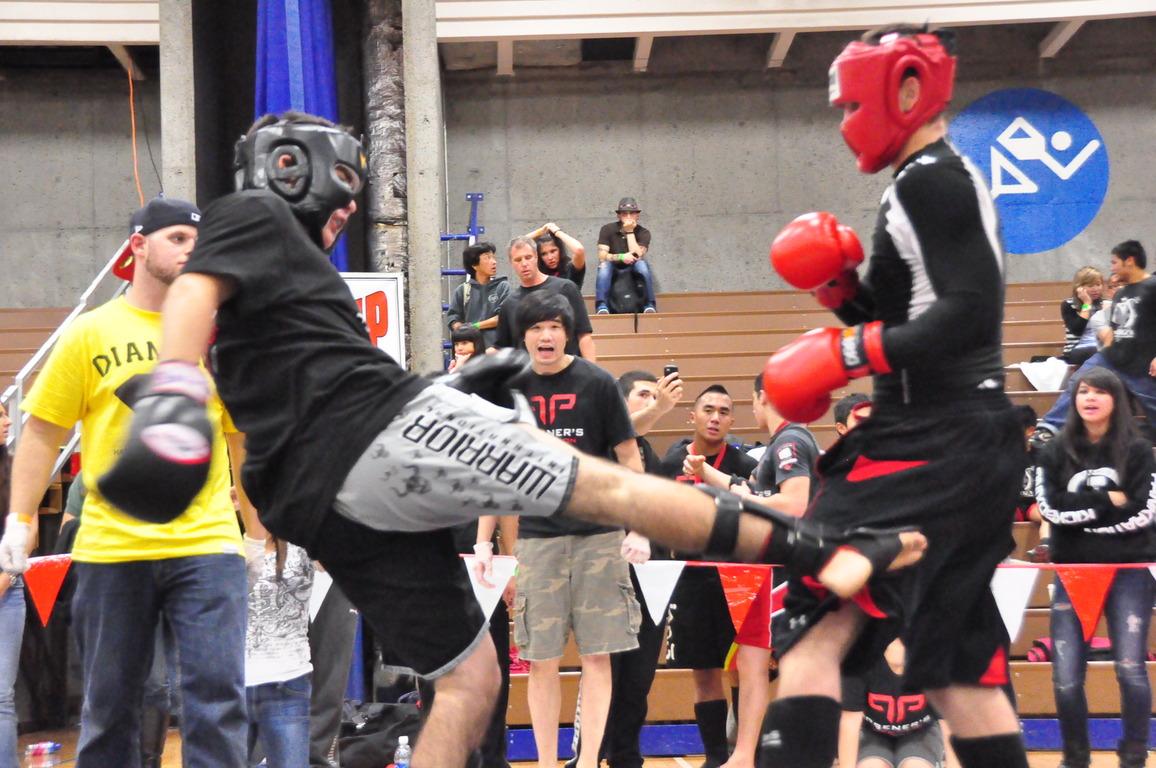
A calf kick attacks the lower leg, below the knee, instead of the thigh. It is one member of the broader family of low kicks. An arcing kick into the calf should also be distinguished from a straight, thrusting attack toward the knee: similar-looking exchanges can involve different targets and mechanics.
There is a documented medical explanation for some of the dramatic reactions. In a 2023 case report, neurologist Nitin Sethi described an MMA athlete with numbness and weakness in lifting the foot after repeated leg kicks. The common peroneal nerve runs around the neck of the fibula, where trauma or swelling can disrupt its function. The report describes a possible injury mechanism, not a diagnosis for every fighter who limps after a kick. Journal of Combat Sports Medicine, pages 83-84.
For viewers, the useful observation is the change in movement. Does a fighter stop planting the lead leg? Do the exits become slower? Does a stance switch protect the sore side while making familiar attacks harder to throw? Those questions keep the analysis grounded in what a fighter is doing, without pretending a broadcast camera can supply a medical examination.
There is no securely established single inventor
The coaching histories overlap. In Marcelo Alonso's 2021 interviews for Sherdog, Katel Kubis said he learned the technique from Fabio Noguchi and introduced it at American Top Team in 2009. Antonio Rodrigo Nogueira recalled Cesar Carneiro urging him to use it in 2008, and identified Amanda Nunes as another early practitioner under Carneiro.
These accounts help explain how the technique travelled between gyms. They do not establish the first calf kick ever thrown. A remembered lesson, an early recorded fight and widespread adoption are different milestones. Alonso's original coaching interviews.
A particularly useful dated example is Wilson Gouveia against Dwayne Lewis at MFC 32 on January 27, 2012. Brian Knapp's contemporary report explicitly describes Gouveia targeting Lewis's calf and knee. The leg attacks preceded a second-round finish with punches on the ground. That is a documented application outside the UFC, nine years before Poirier-McGregor II. Sherdog's MFC 32 report.
The target was also appearing in championship MMA that year. UFC's account of Benson Henderson's August 2012 rematch with Frankie Edgar describes repeated low kicks discoloring Edgar's calf. Henderson won a split decision. The report supplies evidence of early use at the highest level, without proving that the kick decided the contest. UFC 150 report.
How a useful weapon spread
Technique adoption is partly a coaching story. In Jason Burgos's 2018 interviews for Sherdog, Paul Gavoni described showing his athletes Jeremy Stephens's fight with Gilbert Melendez as a demonstration. The fighters subsequently began using calf kicks in practice.
Ray Longo offered another reason for their appeal: the low target made the kick difficult to catch for a takedown. That matters in MMA, where the consequence of a caught kick can extend beyond losing a striking exchange. It is a coach's explanation of an advantage, not a promise that the attacker cannot be countered. Burgos's original interviews.
The examples also caution against measuring success only by a stoppage. An attack can contribute to a decision, open the way for punches or force the opponent into another phase of the fight. A highlight ending on the ground may conceal the standing work that made getting there easier.
Anthony Smith's win over Jimmy Crute at UFC 261 in April 2021 showed a more immediate consequence. UFC's report describes a leg kick dropping Crute, who continued to fight but could not stand on the affected leg during the doctor's assessment. The contest ended at the conclusion of the first round. The observable limitation was enough to end the bout; viewers did not need to invent a more specific diagnosis. UFC 261 results.
The defense keeps evolving
There is no universal answer that works independently of stance, distance and the opponent's other attacks. Alonso's coaching interviews describe different preferences: turning the leg to check the kick, moving the target away, and choosing a response suited to the fighter. Coaches agreed on the problem while differing about the preferred solution. Sherdog's coaching discussion.
Counterpunching offers another route. After fighting Kyoji Horiguchi at RIZIN 38 in September 2022, Kintaro said that meeting Horiguchi's calf kick with a counter had been part of his plan. His account appears in RIZIN's Japanese post-fight interview transcript. Horiguchi ultimately won by submission, but Kintaro's early success showed that the kick itself could create an opening for the opponent. RIZIN's post-fight interviews.
This is why reducing the calf kick to a secret pressure point gives such an incomplete picture. The attacker must still find the target and manage the return. The defender must choose a response that does not simply exchange one vulnerability for another.
What to watch in the next fight
Follow the exchange after the kick as closely as the impact. Watch whether the recipient changes stance, whether the kicker follows with punches, and whether either fighter begins using the threat to draw a predictable reaction. A missed kick that invites a clean counter belongs in the analysis too.
The historical examples establish influence. They do not establish a universal success rate, and a handful of memorable finishes cannot tell us how often an attempted calf kick fails. The technique's enduring importance is that it gives fighters another way to interfere with an opponent's movement and decision-making. Its limits are revealed by the same process: once opponents anticipate the question, they start developing answers.
Reporting & references
Follow the original reporting and records behind this article.
- MMA FightingAlves's interview with Guilherme Cruz
- Journal of Combat Sports MedicineJournal of Combat Sports Medicine, pages 83-84
- SherdogAlonso's original coaching interviews
- SherdogSherdog's MFC 32 report
- UFCUFC 150 report
- SherdogBurgos's original interviews
- UFCUFC 261 results
- RIZIN Fighting FederationRIZIN's post-fight interviews
By the Cage Dispatch editorial desk. Read our editorial policy or report a correction.